
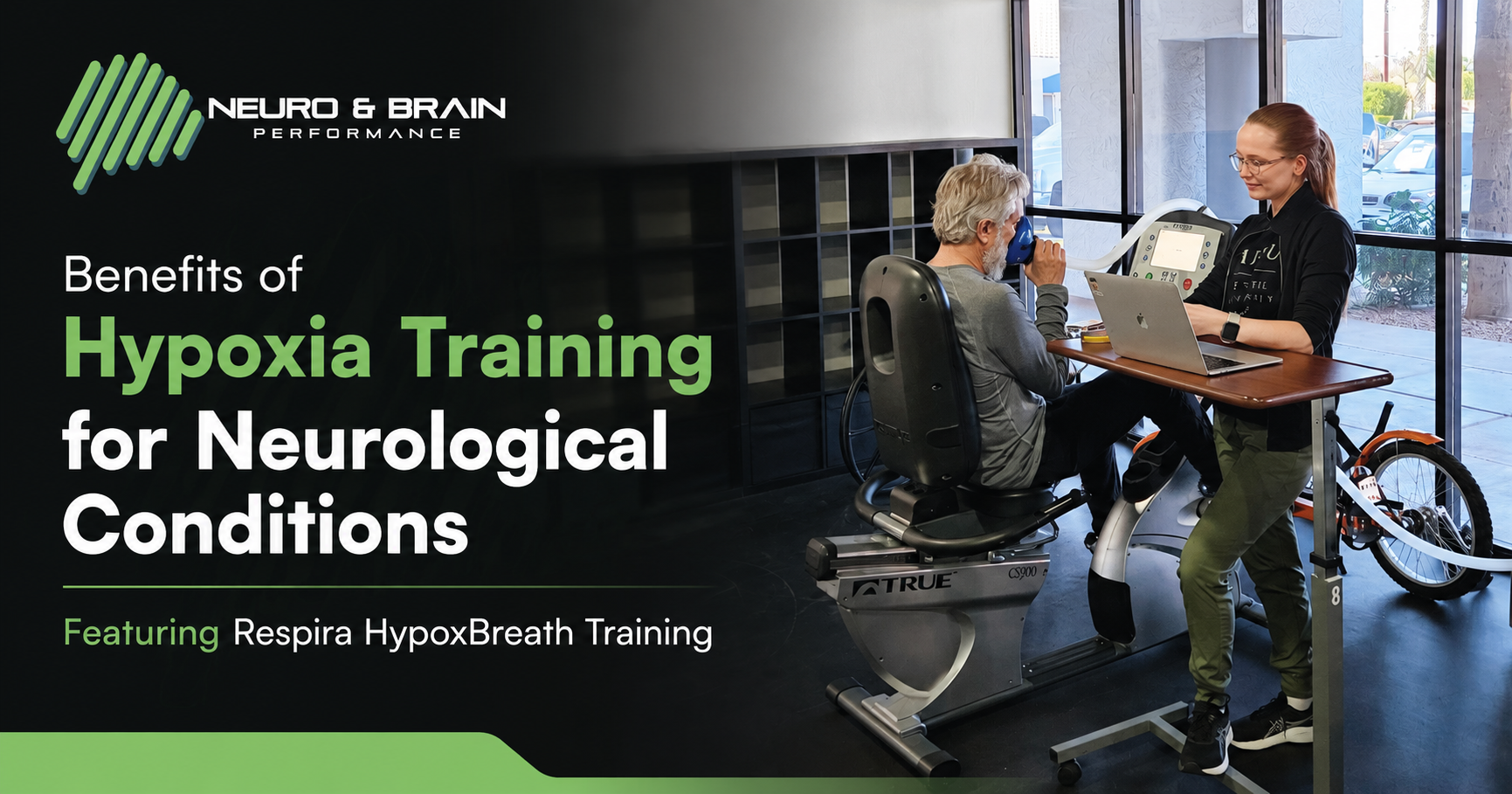
The Benefits of Hypoxia Training for Neurological Rehabilitation
Neurological conditions can affect movement, balance, endurance, coordination, speech, cognition, and a person’s ability to complete everyday activities. Although neurological rehabilitation remains the foundation of treatment, emerging technologies such as intermittent hypoxia-hyperoxia training, or IHHT, may help selected patients improve their response to therapy.
At Neuro & Brain Performance Centers, we use the Respira HypoxBreath® system to provide controlled, individualized hypoxia training. The system alternates periods of reduced-oxygen air with recovery periods, creating a carefully monitored physiological challenge.
This approach is designed to encourage the body to adapt to changing oxygen availability. Researchers are studying whether these adaptations may support neuroplasticity, physical conditioning, cellular energy production, autonomic regulation, and functional recovery in people with certain neurological conditions.
What Is Intermittent Hypoxia-Hyperoxia Training?
Intermittent hypoxia-hyperoxia training involves breathing air with a temporarily reduced oxygen concentration during short, controlled intervals. These intervals are alternated with recovery periods in which the individual receives air with a higher oxygen concentration.
The HypoxBreath system allows our clinical team to provide these alternating phases in a controlled environment. During treatment, the patient relaxes while breathing through a comfortable mask. Oxygen saturation, heart rate, symptoms, and overall response can be monitored throughout the session.
The intensity and duration of each phase can be individualized according to the patient’s health history, oxygen response, tolerance, and rehabilitation goals.
Therapeutic hypoxia training is different from the uncontrolled and repetitive oxygen deprivation associated with untreated sleep apnea. The amount of oxygen reduction, duration of exposure, recovery period, patient selection, and professional supervision are all important components of safe treatment.
How Does the HypoxBreath System Work?
The HypoxBreath system delivers alternating cycles of hypoxia and oxygen-supported recovery.
The hypoxia phase
During the hypoxia phase, the patient temporarily breathes air containing less oxygen than normal room air. This creates a controlled physiological stress that may encourage the body to improve how it responds to changes in oxygen availability.
According to Respira Global, temporarily reducing oxygen levels is intended to stimulate cellular adaptation, mitochondrial activity, energy efficiency, and resilience to physiological stress.
The recovery phase
The hypoxia interval is followed by a recovery phase with increased oxygen availability. This phase allows oxygen saturation to recover and may support circulation, metabolic recovery, and tissue function.
These cycles are repeated according to an individualized protocol. The goal is not to deprive the body of oxygen for an extended period. Instead, treatment creates brief, monitored changes in oxygen availability that encourage an adaptive response.
How Could Hypoxia Training Support Neurological Recovery?
A carefully controlled reduction in oxygen creates a mild physiological challenge. In response, the body may activate adaptive pathways involving the nervous, cardiovascular, respiratory, and muscular systems.
One of the most promising areas of research involves neuroplasticity—the nervous system’s ability to reorganize, strengthen neural connections, and develop new strategies for performing a movement or task.
Brief intermittent hypoxia may activate serotonin-dependent pathways and other cellular processes associated with plasticity in the brain and spinal cord. Researchers believe this may temporarily make portions of the nervous system more responsive to task-specific rehabilitation.
This means hypoxia training may be particularly valuable when it is incorporated into a comprehensive neurological rehabilitation program that includes activities such as walking practice, balance training, strengthening, upper-extremity exercises, respiratory training, or other goal-directed interventions.
Potential Benefits of Hypoxia Training
1. May Promote Neuroplasticity
Neuroplasticity is central to rehabilitation following a stroke, spinal cord injury, brain injury, or neurological diagnosis. Repeated practice helps the nervous system strengthen the pathways involved in movement and function.
Controlled intermittent hypoxia may stimulate biological signals associated with neural adaptation and motor learning. Research has identified possible effects on neurotrophic factors, vascular responses, inflammation, oxidative stress, and other mechanisms connected to nervous-system plasticity.
Research across many neurological diagnoses remains preliminary, however. Proposed benefits should not be interpreted as proof that hypoxia training can reverse neurological damage or cure a neurological condition.
2. May Support Walking and Mobility
Some of the strongest human evidence for acute intermittent hypoxia comes from studies involving people with incomplete spinal cord injuries.
Researchers have investigated whether intermittent hypoxia can improve walking speed, walking endurance, lower-extremity function, and the nervous system’s ability to activate muscles. Results have been encouraging in selected patients, particularly when hypoxia exposure is paired with walking or gait training.
Researchers are also exploring whether intermittent hypoxia can enhance walking rehabilitation following a stroke. This remains an emerging clinical application rather than an established standard of care.
3. May Support Strength and Motor Function
Neurological conditions can make it difficult for the nervous system to fully recruit and control muscles.
Intermittent hypoxia may temporarily increase the responsiveness of motor pathways, potentially helping some patients produce more effective muscle contractions during therapy. Studies involving chronic spinal cord injury have reported possible improvements in upper-extremity strength and hand function.
Larger studies are still needed to determine which patients are most likely to benefit, what treatment dose is most effective, and how long improvements may last.
4. May Improve Exercise Tolerance
Fatigue and reduced cardiovascular endurance are common after neurological injury and among people living with chronic neurological conditions.
Controlled hypoxia training may encourage adaptations related to oxygen utilization, circulation, cellular energy production, and tolerance for physical activity. Improved exercise tolerance could help a patient participate more fully in walking, strengthening, balance training, and everyday activities.
Improvements in general conditioning should not automatically be interpreted as direct neurological recovery. However, greater endurance may allow a patient to perform more meaningful and productive rehabilitation activities.
5. May Support Mitochondrial Function
Mitochondria are the structures within cells that help convert nutrients and oxygen into usable energy. Reduced mitochondrial efficiency may contribute to fatigue, reduced exercise tolerance, and slower recovery.
Respira describes HypoxBreath training as a way to encourage adaptations related to mitochondrial function and energy efficiency through alternating hypoxia and recovery phases.
For neurological rehabilitation patients, improved cellular energy efficiency may potentially support endurance and participation in therapy. More research is needed to determine how consistently these physiological changes translate into measurable functional improvements for each neurological diagnosis.
6. May Support Autonomic Nervous System Regulation
The autonomic nervous system helps regulate functions such as heart rate, blood pressure, breathing, digestion, temperature control, and the body’s response to stress.
Neurological injuries and chronic neurological conditions can sometimes disrupt autonomic regulation. Respira states that its intermittent hypoxia training approach is intended to help calm and regulate autonomic nervous-system activity.
A more balanced autonomic response may potentially support relaxation, recovery, sleep quality, stress tolerance, and overall readiness for rehabilitation. Individual responses vary, and hypoxia training should not replace medical treatment for diagnosed autonomic disorders.
7. May Support Respiratory Function
Certain spinal cord injuries and neurological conditions affect the muscles and neural pathways responsible for breathing.
Acute intermittent hypoxia is being studied as a method for promoting plasticity in respiratory pathways and improving the nervous system’s activation of breathing muscles. This may eventually provide another treatment option for selected people with neurologically related respiratory weakness.
This application requires careful screening and supervision, especially for individuals with respiratory disease, cardiovascular conditions, impaired autonomic control, or reduced baseline oxygen saturation.
8. May Enhance the Effects of Neurological Therapy
Hypoxia training is not intended to replace physical therapy, occupational therapy, speech therapy, medical treatment, or a patient’s prescribed exercise program.
Its greatest potential may be as a priming intervention used before or in coordination with rehabilitation. The controlled oxygen challenge may create a temporary period during which the nervous system is more responsive to repetitive, task-specific practice.
Depending on the patient’s goals, HypoxBreath training may be incorporated into a rehabilitation program that also includes:
- Neurological physical therapy
- Walking and gait training
- Balance and vestibular activities
- Functional strengthening
- Upper-extremity rehabilitation
- Coordination exercises
- Respiratory muscle training
- Cardiovascular conditioning
- Task-specific movement practice
- Brain performance training
The rehabilitation activity remains essential. Hypoxia exposure alone does not teach the nervous system how to walk, balance, reach, communicate, or complete daily activities.
Which Neurological Conditions Are Being Studied?
Therapeutic intermittent hypoxia has been most extensively studied in people with incomplete spinal cord injuries. Researchers are also exploring its possible role in rehabilitation and conditioning programs for people affected by:
- Stroke
- Traumatic brain injury
- Multiple sclerosis
- Parkinson’s disease
- Age-related neurological decline
- Neurologically related respiratory weakness
- Other conditions affecting movement and nervous-system function
The amount and quality of evidence differ significantly by diagnosis. Evidence supporting potential motor improvements following incomplete spinal cord injury is more developed than the evidence available for many brain injuries and progressive neurodegenerative conditions.
Hypoxia training should therefore be recommended based on the individual patient—not simply on the name of a diagnosis.
What Is a HypoxBreath Session Like?
A HypoxBreath session is generally performed while the patient rests in a comfortable position.
The patient breathes through a mask connected to the system. The equipment then provides alternating periods of reduced-oxygen air and oxygen-supported recovery according to the selected protocol.
During the session, our team may monitor:
- Blood oxygen saturation
- Heart rate
- Breathing response
- Symptoms
- Comfort and tolerance
- Recovery between hypoxia intervals
Patients may experience a change in breathing awareness, mild warmth, relaxation, or temporary fatigue. Any concerning symptoms should be reported immediately so the treatment can be adjusted or stopped.
The number and frequency of sessions depend on the patient’s health, goals, response to treatment, and overall rehabilitation plan.
Is Hypoxia Training Safe?
Intermittent hypoxia training has generally been well tolerated by carefully screened research participants when delivered at an appropriate dose and under professional supervision.
Safety depends on the patient’s medical history, baseline oxygen saturation, severity of oxygen reduction, session duration, recovery intervals, and monitoring procedures.
Hypoxia training may not be appropriate for everyone. Additional medical clearance or caution may be necessary for people with:
- Unstable cardiovascular disease
- Uncontrolled high blood pressure
- Significant respiratory disease
- Severe anemia
- Certain heart rhythm disorders
- A history of fainting
- Poor tolerance for reduced oxygen
- Uncontrolled seizures
- Pregnancy
- Untreated sleep-disordered breathing
- Acute illness or infection
- Other medically unstable conditions
Patients should be screened before beginning treatment. Hypoxia training should not be attempted independently using unregulated equipment or improvised methods.
A Promising Tool—Not a Cure
Hypoxia training is an exciting area of neurological rehabilitation and human-performance research, but it should not be presented as a cure for stroke, spinal cord injury, traumatic brain injury, Parkinson’s disease, multiple sclerosis, or another neurological condition.
Current evidence suggests that carefully dosed intermittent hypoxia may support neuroplasticity, strength, walking, breathing, endurance, or exercise participation in selected patients.
Researchers are still working to determine:
- Which diagnoses respond best
- Which patients are appropriate candidates
- The ideal oxygen concentration
- The ideal duration of each interval
- The recommended number of sessions
- How frequently treatment should be performed
- Which rehabilitation activities should accompany treatment
- How long potential improvements last
Hypoxia training should be individualized and incorporated into a comprehensive neurological rehabilitation or performance program.
HypoxBreath Training at Neuro & Brain Performance Centers
At Neuro & Brain Performance Centers, we use the Respira HypoxBreath system as part of our commitment to bringing innovative, evidence-informed technology into neurological rehabilitation.
Our team evaluates each person’s medical history, current abilities, oxygen response, functional limitations, and rehabilitation goals before recommending hypoxia training.
When appropriate, HypoxBreath training may be combined with neurological physical therapy, occupational therapy, speech therapy, brain performance training, cardiovascular conditioning, and other targeted interventions.
Our goal is not simply to complete a hypoxia session. Our goal is to use the technology strategically to help each patient participate more effectively in rehabilitation and work toward meaningful improvements in mobility, endurance, independence, and quality of life.
Could Hypoxia Training Be Right for You?
Hypoxia training is not appropriate for every patient, and results vary. A professional evaluation is necessary to determine whether it may be a safe and beneficial addition to your program.
Contact Neuro & Brain Performance Centers to learn more about Respira HypoxBreath training and schedule an individualized evaluation.
