
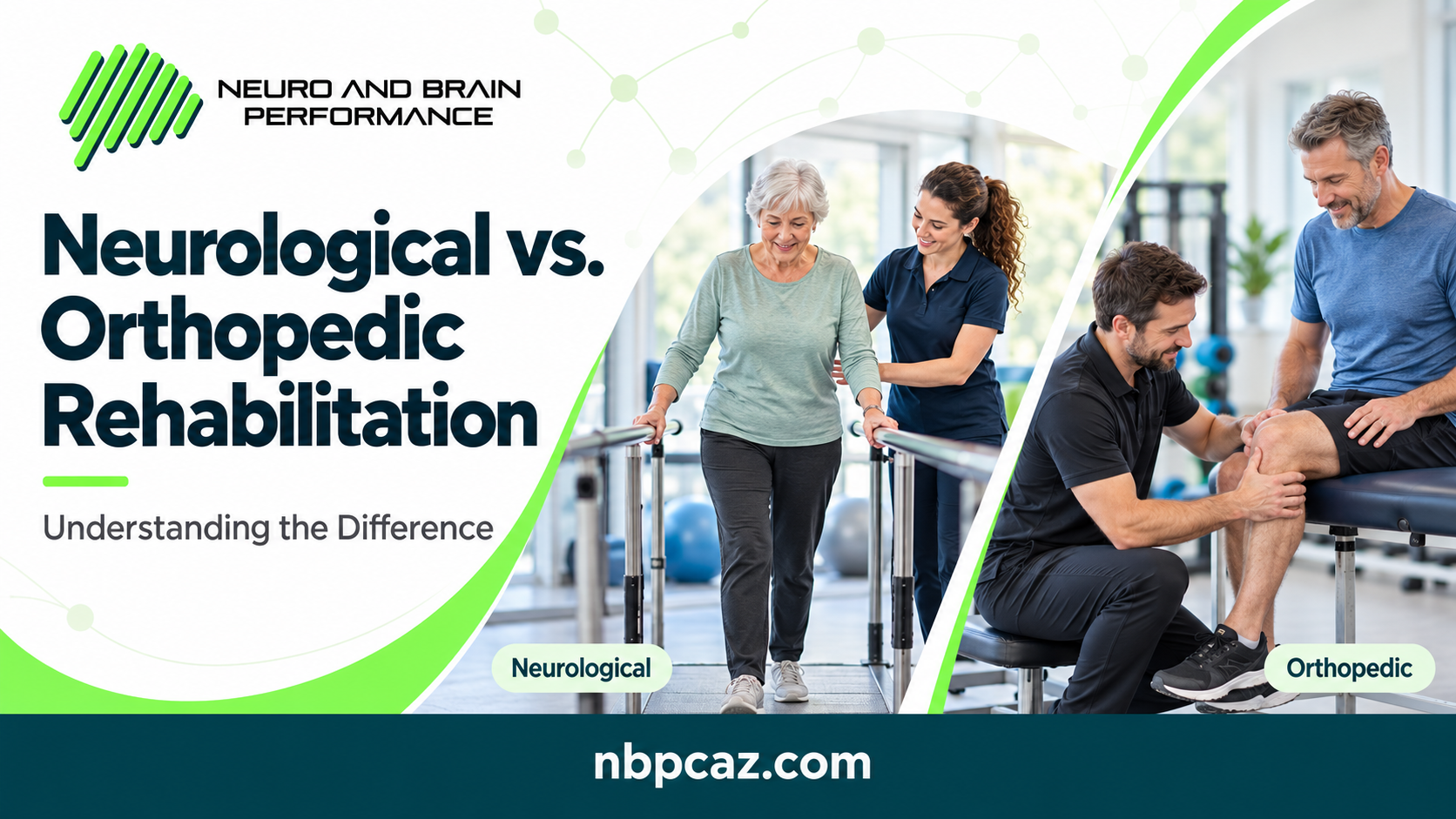
How Neurological Rehabilitation Differs From Orthopedic Rehabilitation
Difficulty walking, reaching, or getting through everyday activities can have very different causes. A painful knee may limit movement because of a joint injury. After a stroke, movement may be limited because the nervous system has difficulty coordinating or activating the muscles. Understanding that difference helps explain why neurological rehabilitation requires a specialized approach.
At Neuro & Brain Performance Centers in Mesa, Arizona, we provide neurological physical therapy, occupational therapy, and speech therapy. We personalize care around how your condition affects your life, with goals that may include walking more safely, using your hands, communicating, or becoming more independent at home.
What Orthopedic Rehabilitation Focuses On
Orthopedic rehabilitation primarily addresses injuries and conditions involving muscles, bones, joints, tendons, and ligaments. Common examples include arthritis, fractures, shoulder injuries, back pain, and recovery after a joint replacement. Treatment often focuses on reducing pain, restoring range of motion, rebuilding strength, and gradually returning to work, exercise, or daily activities.
What Makes Neurological Rehabilitation Different
Neurological rehabilitation addresses conditions affecting the brain, spinal cord, or nerves. These include stroke, traumatic brain injury, Parkinson’s disease, multiple sclerosis, and spinal cord injury. A neurological condition can change how a person initiates movement, maintains balance, processes sensation, or coordinates different parts of the body.
Treatment may also need to address muscle stiffness or spasticity, visual difficulties, attention, memory, fatigue, and communication. For example, a person recovering from a stroke may need to practice shifting weight onto one leg, recognizing obstacles on the affected side, and coordinating each step. Strengthening can help, but the therapist must also consider how the nervous system controls the activity.
The two approaches overlap. Both use exercise, movement practice, education, and strategies to improve function. A person with a neurological condition can also develop orthopedic pain or stiffness. The difference is the underlying problem and how therapy is adapted to address it.
Helping the Nervous System Learn Through Practice
Neuroplasticity is the nervous system’s ability to adapt and reorganize its connections. Meaningful, repeated practice is a central part of neurological rehabilitation. Your therapist selects activities that challenge your abilities at an appropriate level, provides feedback, and adjusts the task as you progress.
That practice should connect to something useful: stepping over a threshold, reaching for a cup, fastening a button, or following a conversation. Depending on the condition, goals may include recovering skills, maintaining function, learning compensatory strategies, or adapting activities as needs change.
How Our Specialized Equipment Supports Therapy
At NBPC, technology gives our therapists additional ways to adapt movement and cognitive challenges. Equipment is selected according to your evaluation, safety needs, and goals. Each tool supports a treatment plan rather than determining it.
AlterG for Supported Walking Practice
The AlterG Anti-Gravity Treadmill uses air pressure to support a portion of your body weight while you walk. Your therapist can adjust the support to make stepping more manageable and gradually change the challenge. For appropriate patients, this creates an opportunity to practice gait with less loading and greater confidence. In neurological rehabilitation, sessions may emphasize step quality, walking endurance, and coordinated movement.
AiroSystem for Controlled Oxygen Training
AiroSystem delivers intermittent hypoxia–hyperoxia training through a mask, alternating periods of lower and higher oxygen. At NBPC, this may be considered as an adjunct to rehabilitation for selected patients after clinical screening and with monitoring.
Research on related acute intermittent hypoxia protocols has shown promising walking improvements in some people with incomplete spinal cord injury when paired with walking practice. Those findings do not establish the same benefits for AiroSystem’s specific protocol or every neurological condition. This is an emerging approach whose suitability depends on the individual and the treatment protocol.
Pilates Reformer for Controlled Movement
Our Pilates Reformer uses adjustable spring resistance and a moving carriage to assist or challenge exercise. A therapist can adapt positions and resistance to practice trunk control, posture, limb movement, and coordination. For someone with neurological movement difficulties, it offers another way to work on controlled movement with support matched to their abilities.
CogniFit for Cognitive Practice
CogniFit provides computerized cognitive activities and assessment tasks that can help guide practice in areas such as attention, memory, and processing speed. As described on our website, our therapists can monitor assigned home activities and use the information to guide work in the clinic. The goal is to connect cognitive practice with everyday demands, such as following directions or organizing a routine. Computerized activities complement clinical assessment and functional therapy.
FitLight for Visual and Movement Challenges
FitLight uses illuminated targets to create customizable tasks that combine movement with visual attention and response timing. A therapist may ask you to reach for selected lights, shift your weight, or follow a changing sequence. These activities can challenge coordination, visual scanning, focused or divided attention, and processing speed. Immediate feedback helps the therapist adjust the task and track performance.
FitMi for Repetition and Feedback
FitMi is an interactive rehabilitation system that uses sensor pucks and onscreen feedback to guide repeated movement practice. It can make exercises more engaging while helping patients see their progress during a session. Our therapists can incorporate it into practice for the arms, hands, legs, or trunk when appropriate. Repetition supports learning, while therapist guidance helps keep the exercise relevant to your goals and abilities.
Care That Connects Therapy to Daily Life
Neurological recovery often involves several aspects of daily function. Our physical therapists address walking, balance, and mobility. Our occupational therapists help with hand use, self-care, and other meaningful activities. Speech therapy can address communication and cognitive-communication needs. Bringing these services together helps us work toward goals that matter beyond the clinic.
If you or a loved one is living with a neurological condition, an individualized evaluation can help identify the right approach. Learn more about our neurological physical therapy and neurological occupational therapy services at nbpcaz.com.
Call Neuro & Brain Performance Centers at (480) 719-8080 to discuss an evaluation. Visit us at 5761 E. Brown Road, Suite 19, Mesa, AZ 85207. We serve patients throughout the East Valley.