
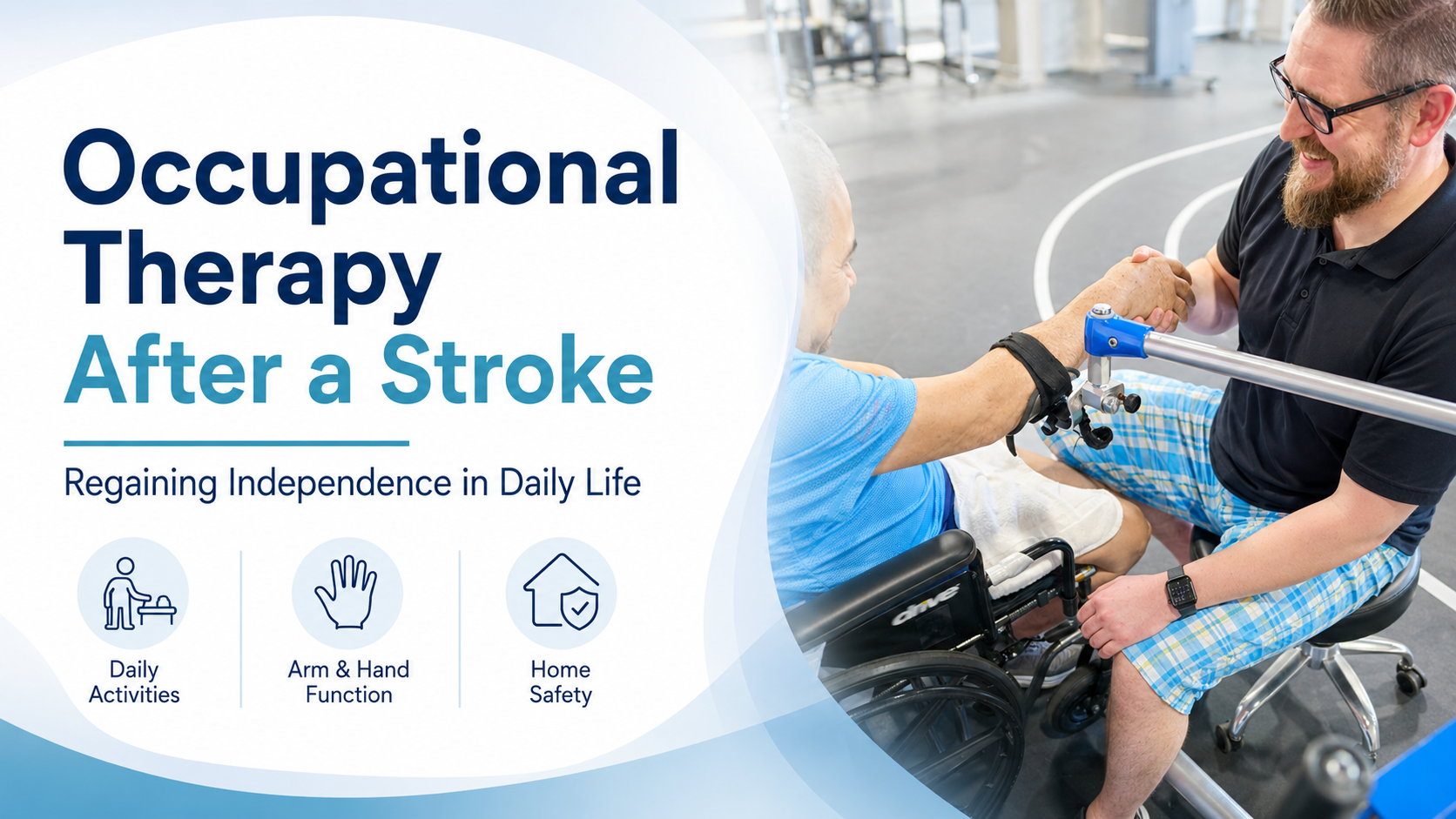
Occupational Therapy After a Stroke: Regaining Independence in Daily Life
A stroke can change much more than a person’s ability to walk. Everyday activities that once felt automatic—getting dressed, preparing a meal, taking a shower, writing a note, using a phone, or returning to work—may suddenly become difficult.
That is where occupational therapy after a stroke can play an important role.
Occupational therapists help stroke survivors work toward greater independence by addressing the physical, cognitive, visual, sensory, and functional challenges that can interfere with daily life. Stroke rehabilitation frequently involves a coordinated team that includes occupational therapy, physical therapy, and speech-language therapy.
At Neuro & Brain Performance Centers in Mesa, Arizona, neurological occupational therapy is part of a comprehensive rehabilitation approach for people recovering from stroke and other neurological conditions.
What Does an Occupational Therapist Do After a Stroke?
The word “occupation” in occupational therapy does not refer only to a job. It refers to the meaningful activities that make up everyday life.
These may include:
- Dressing
- Bathing and grooming
- Preparing meals
- Eating
- Using the bathroom
- Managing medications
- Writing or typing
- Using a phone or computer
- Performing household tasks
- Driving or community mobility
- Returning to work
- Participating in hobbies
- Caring for family members
Occupational therapy focuses on helping people participate as fully and safely as possible in the activities that matter to them. Professional occupational therapy guidelines for adults after stroke emphasize participation and performance in meaningful activities for both stroke survivors and their caregivers.
How Can a Stroke Affect Daily Activities?
The effects of a stroke vary depending on which areas of the brain were affected and the severity of the injury.
A stroke survivor may experience challenges such as:
Arm and Hand Weakness
Weakness or paralysis on one side of the body can make it difficult to reach, grasp, carry, button clothing, use utensils, or complete other everyday tasks.
Reduced Fine Motor Control
Activities such as fastening a zipper, handling coins, writing, using keys, or operating a smartphone require precise hand and finger movements. Fine motor rehabilitation is one area occupational therapy may address after stroke.
Changes in Sensation
Some people experience numbness, tingling, reduced awareness of temperature, or difficulty recognizing where an arm or hand is positioned.
Reduced sensation can create safety concerns during activities such as cooking, bathing, or carrying hot objects.
Problems With Balance and Coordination
Stroke can affect postural control and coordination, which may make dressing, showering, cooking, or moving around the home more difficult.
Visual Changes
A stroke may cause visual field loss, difficulty tracking objects, reduced depth perception, or problems interpreting visual information.
These changes can affect reading, driving, navigating environments, and completing household tasks.
Cognitive Changes
Stroke can also affect:
- Memory
- Attention
- Problem-solving
- Organization
- Planning
- Judgment
- Processing speed
These cognitive skills are essential for many complex daily activities, including managing finances, following a recipe, taking medications correctly, and returning to work.
How Occupational Therapy Helps Stroke Survivors
Occupational therapy treatment is individualized based on the person’s abilities, challenges, lifestyle, and personal goals.
Practicing Activities of Daily Living
One of the primary goals of occupational therapy is helping people regain independence with everyday activities.
Therapy may involve practicing:
- Dressing
- Grooming
- Showering
- Toileting
- Eating
- Transfers
- Meal preparation
Stroke rehabilitation guidance specifically recommends occupational therapy for people who have difficulty performing personal activities of daily living.
Rather than exercising a movement in isolation, an occupational therapist may incorporate that movement into a meaningful task.
For example, reaching exercises might involve retrieving an item from a cabinet. Hand exercises might involve buttoning a shirt or holding a utensil.
Improving Arm and Hand Function
Upper-extremity recovery is often an important part of occupational therapy after stroke.
Treatment may focus on:
- Reaching
- Grasping
- Releasing objects
- Hand strength
- Finger coordination
- Bilateral hand use
- Shoulder movement
- Arm positioning
- Functional use of the affected side
The goal is not simply to improve movement—it is to help the person use that movement during meaningful activities.
Research reviewed by occupational therapy experts supports interventions such as upper-extremity training as part of post-stroke rehabilitation.
Addressing Cognitive Challenges
Physical recovery is only one part of stroke rehabilitation.
Cognitive difficulties can sometimes be less visible but may have a major impact on independence.
An occupational therapist may help a stroke survivor develop strategies for:
- Remembering appointments
- Organizing daily routines
- Following multi-step tasks
- Managing medications
- Planning meals
- Using calendars or reminders
- Improving attention
- Completing work-related tasks
Cognitive training is among the occupational therapy interventions studied for improving participation following stroke.
Improving Safety at Home
Returning home after a stroke can reveal challenges that were not obvious in a hospital or rehabilitation facility.
An occupational therapist may evaluate how a person functions in environments similar to their home and recommend ways to improve safety and independence.
Recommendations might include:
- Grab bars
- Shower chairs
- Raised toilet seats
- Adaptive utensils
- Dressing equipment
- Improved lighting
- Removing trip hazards
- Rearranging commonly used items
- Modifying kitchen or bathroom routines
Occupational therapists may also assess a stroke survivor’s ability to manage safely at home and participate in the community.
Learning New Ways to Complete Tasks
Recovery does not always mean completing an activity exactly the way it was performed before the stroke.
Sometimes the best strategy is to adapt.
An occupational therapist may teach alternative techniques that allow a person to complete an activity more safely or independently.
For example:
- Dressing the affected side first
- Using one-handed techniques
- Sitting during certain activities
- Using adaptive equipment
- Breaking complex activities into smaller steps
- Changing the setup of the home
These strategies can help reduce frustration while allowing the individual to participate more fully in daily life.
Returning to Work and Meaningful Activities
For many stroke survivors, recovery goals extend beyond basic self-care.
They may want to return to:
- Employment
- Gardening
- Golf
- Cooking
- Crafts
- Community activities
- Exercise
- Parenting
- Volunteering
- Driving
- Social activities
Returning to work after a stroke can be complex because stroke may leave ongoing physical, cognitive, communication, and fatigue-related challenges.
Occupational therapy can help identify the specific demands of an activity and develop strategies for working toward that goal.
Occupational Therapy and Neuroplasticity
One of the principles behind neurological rehabilitation is the brain’s ability to adapt through neuroplasticity.
Repeated, meaningful practice can help reinforce movement patterns and functional skills.
At Neuro & Brain Performance Centers, rehabilitation incorporates techniques designed to engage the brain through repetitive movement and feedback as part of neurological recovery.
This is one reason occupational therapy frequently uses real-world tasks rather than relying only on generalized exercises.
How Long After a Stroke Can Occupational Therapy Help?
Recovery after stroke does not follow the same timeline for everyone.
Some of the fastest improvements may occur earlier in recovery, but progress can continue over time. The American Stroke Association notes that improvements may still be possible even after the initial pace of recovery slows.
That means someone who had a stroke months or even years ago may still benefit from an evaluation if they have goals related to independence, arm and hand function, daily activities, cognition, work, or community participation.
Signs Occupational Therapy May Be Appropriate
Consider an occupational therapy evaluation if a stroke survivor is having difficulty with:
- Dressing or grooming
- Bathing
- Cooking
- Using an affected arm or hand
- Writing or typing
- Memory or organization
- Returning to work
- Household activities
- Vision-related tasks
- Using adaptive equipment
- Participating in hobbies
- Completing daily routines independently
Occupational therapy can also be helpful when a person has made physical progress but still struggles to translate that progress into everyday activities.
A Team Approach to Stroke Rehabilitation
Stroke can affect many areas of function at the same time.
That is why rehabilitation often involves several disciplines.
Physical therapy may focus on walking, balance, strength, transfers, and mobility.
Occupational therapy focuses on independence and participation in daily activities.
Speech therapy may address communication, cognition, voice, and swallowing.
A coordinated multidisciplinary approach allows therapists to address different parts of recovery while working toward common goals. Stroke rehabilitation guidelines recognize occupational therapists as part of the larger coordinated rehabilitation team.
Neurological Occupational Therapy in Mesa, Arizona
Neuro & Brain Performance Centers provides specialized neurological occupational therapy for people recovering from stroke and other neurological conditions.
Our neurological rehabilitation team works with patients to identify the activities that matter most to them and develop individualized treatment plans designed to improve function, safety, confidence, and independence.
Learn more about neurological occupational therapy at Neuro & Brain Performance Centers and how our team may help you or your loved one work toward greater independence after a stroke.
Neuro & Brain Performance Centers serves patients in Mesa and surrounding East Valley communities, including Tempe, Chandler, Gilbert, and Apache Junction.
Take the Next Step
Recovering after a stroke can be challenging, but progress is not measured only by walking farther or becoming stronger. Being able to button a shirt, prepare breakfast, use a phone, return to a hobby, care for yourself, participate in your community, these everyday accomplishments can have a meaningful impact on independence and quality of life.
If a stroke has made daily activities difficult for you or a loved one, a neurological occupational therapy evaluation may help identify opportunities for continued improvement.